- contact@digimenial.com
- Noida. UP

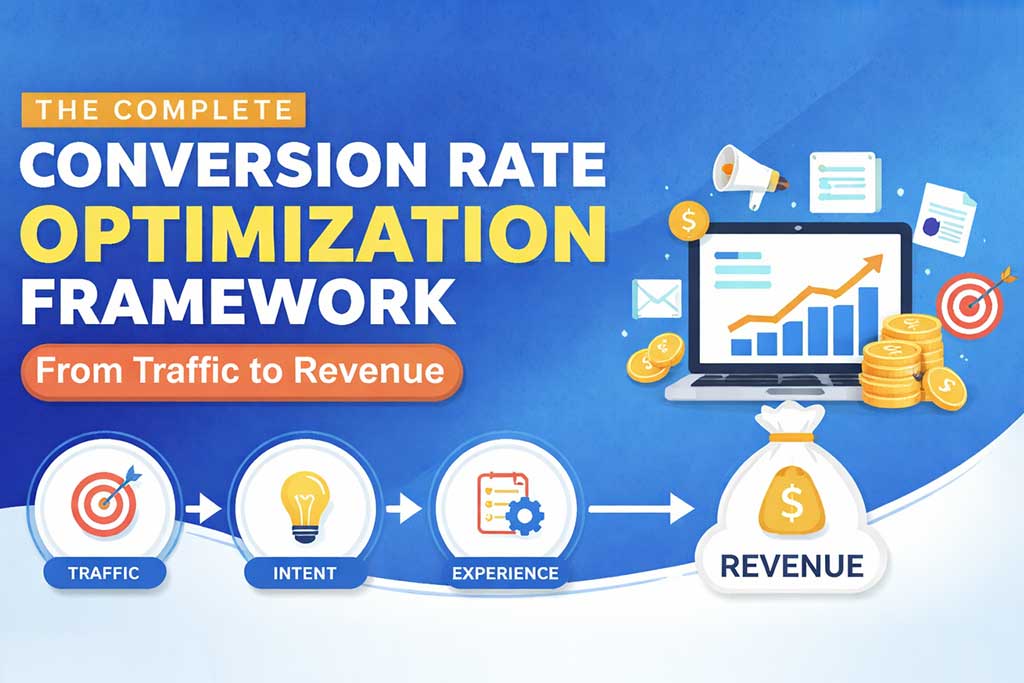
The Complete Conversion Rate Optimization Framework: From Traffic to Revenue
19
Mar
Most businesses think CRO is about tweaking landing pages or running A/B tests.
But real Conversion Rate Optimization is much bigger than that.
It’s not just about improving a page — it’s about improving how your entire business turns attention into revenue. When done right, CRO becomes a system that connects marketing, user experience, and customer psychology into one growth engine.
What Conversion Rate Optimization Really Means
CRO is often misunderstood as a set of tools or experiments. In reality, it’s a structured way of understanding why people take action — or don’t — and improving that journey across touchpoints. It’s less about buttons and more about decision-making behavior.
- – CRO is not just A/B testing — it’s decision optimization
- – It aligns messaging, experience, and user expectations
- – It connects acquisition (traffic) with outcomes (revenue)
- – It focuses on why users convert, not just how many do
According to studies by organizations like Nielsen Norman Group, users form an impression of a website in under 0.05 seconds, which shows how critical early experience is.
The CRO Ecosystem: Traffic, Intent, Experience
CRO doesn’t work in isolation. It sits at the intersection of three critical elements: traffic quality, user intent, and page experience. If any one of these is misaligned, conversions suffer — even if the other two are strong.
- – Traffic quality: Are you attracting the right audience?
- – Intent match: Does your message match what users expect?
- – Experience: Is the journey smooth, clear, and trustworthy?
Think of CRO like a chain. If one link breaks, the entire system weakens.
Research from HubSpot shows that companies aligning content with user intent see 2–3x higher conversion rates compared to generic messaging.
Pre-CRO Checklist: What Must Be Right Before You Optimize
Before running experiments, you need to ensure foundational elements are solid. Many CRO efforts fail because teams jump into testing without fixing basic issues like unclear offers or poor targeting.
- – Offer clarity: Can users understand your value in seconds?
- – Audience clarity: Are you targeting the right segment?
- – Channel-message alignment: Does your ad/SEO promise match the page?
- – Tracking accuracy: Are your analytics reliable?
If these are broken, no amount of testing will fix conversions.
In fact, research suggests that over 70% of A/B tests fail to produce significant results, often due to weak hypotheses or poor foundations.
CRO Framework by Funnel Stage
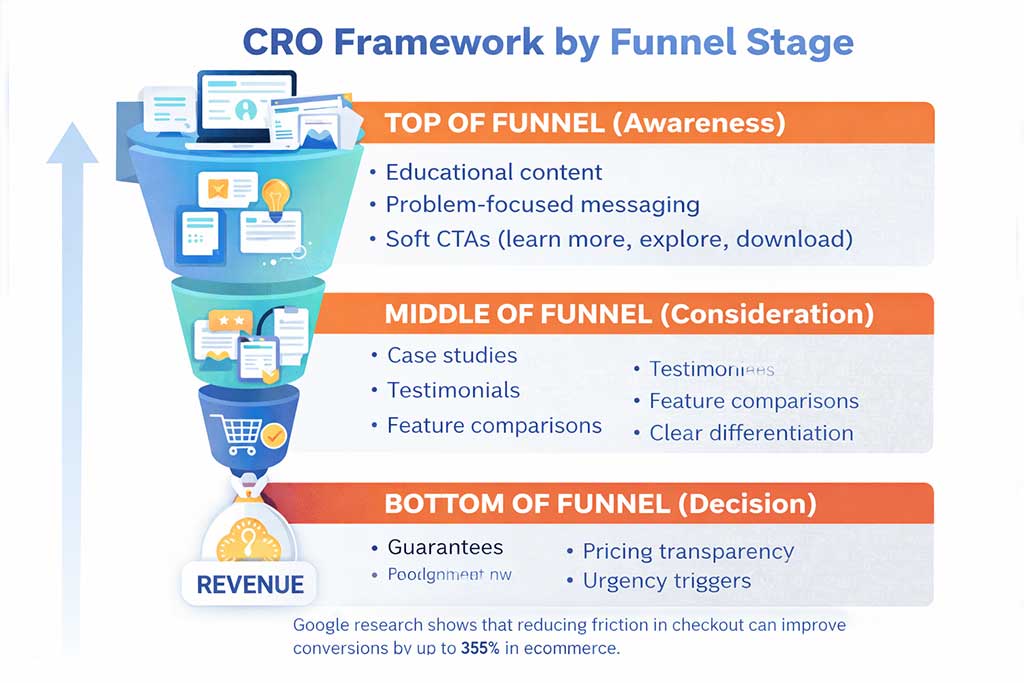
Different users are at different stages of decision-making. Treating all visitors the same is one of the biggest CRO mistakes. Instead, your approach should change based on where users are in the funnel.
Top of Funnel (Awareness)
Users are exploring and learning. They need clarity and trust, not pressure.
- – Educational content
- – Problem-focused messaging
- – Soft CTAs (learn more, explore, download)
Middle of Funnel (Consideration)
Users are comparing options and evaluating credibility.
- – Case studies
- – Testimonials
- – Feature comparisons
- – Clear differentiation
Bottom of Funnel (Decision)
Users are ready but hesitant. Reduce risk and remove friction.
- – Guarantees
- – Pricing transparency
- – Urgency triggers
- – Easy checkout or form flow
Google research shows that reducing friction in checkout can improve conversions by up to 35% in ecommerce.
CRO for Different Business Models
CRO strategies vary depending on the business model. What works for ecommerce may not work for SaaS or lead generation. Understanding this difference is key to meaningful optimization.
Lead Generation (Services, B2B)
- – Focus on trust and authority
- – Use strong case studies
- – Optimize lead qualification
SaaS & Subscriptions
- – Highlight product value early
- – Offer trials or demos
- – Reduce onboarding friction
Ecommerce
- – Optimize product pages and checkout
- – Focus on urgency and social proof
- – Improve cart experience
Local Businesses
- – Prioritize trust and proximity
- – Use reviews and testimonials
- – Make contact actions easy (call, visit, book)
Each model has a different conversion journey — and CRO must adapt accordingly.
CRO Metrics That Drive Revenue (Not Vanity)
Many businesses focus only on conversion rate, but that’s just one part of the picture. Real CRO success comes from understanding metrics that directly impact revenue.
- – Conversion rate vs conversion value
- – Revenue per visitor
- – Lead-to-sale ratio
- – Customer lifetime value (LTV)
- – Assisted conversions
For example, increasing conversion rate from 2% to 3% is good. But increasing average order value by 40% may have a much bigger revenue impact.
According to McKinsey, companies that focus on customer lifetime value can increase profitability by up to 25–95% over time.
When CRO Is Not the Solution
Sometimes, conversion problems are not CRO problems at all. Optimizing pages won’t help if the core business offering has deeper issues.
- – Weak product-market fit
- – Poor pricing strategy
- – Unclear positioning
- – Low market demand
If users don’t see value, they won’t convert — no matter how optimized the page is.
A common sign: high traffic + low engagement + poor retention.
This is where businesses need strategic fixes, not just CRO tweaks.
A Practical CRO Roadmap
CRO should follow a structured process instead of random experimentation. A clear roadmap helps teams move from insights to measurable results.
Phase 1: Diagnosis
- – Analyze data and user behavior
- – Identify drop-offs and friction points
Phase 2: Hypothesis Building
- – Create testable assumptions
- – Prioritize based on impact and effort
Phase 3: Testing & Iteration
- – Run controlled experiments
- – Measure results accurately
Phase 4: Scaling Learnings
- – Apply winning insights across pages
- – Align findings with marketing channels
Companies with structured CRO programs often see consistent growth improvements of 20–30% annually.
How All Your Marketing Channels Should Feed CRO
CRO doesn’t sit at the end of the funnel — it connects with every marketing channel. When aligned properly, each channel contributes to better conversion insights and outcomes.
- – SEO → validates user intent
- – Paid Ads →test messaging quickly
- – Social Media → builds awareness and interest
- – CRO → converts and optimizes outcomes
Together, they form a loop:
Traffic → Behavior → Insights → Optimization → Revenue
This loop is where real growth happens.
Final Thoughts
Conversion Rate Optimization is not a tactic – it’s a mindset.
It’s about understanding your customers deeply, aligning your messaging with their intent, and creating an experience that makes taking action feel natural.
When CRO is done right, you don’t just improve metrics.
You build a system that consistently turns attention into revenue.