- contact@digimenial.com
- Noida. UP

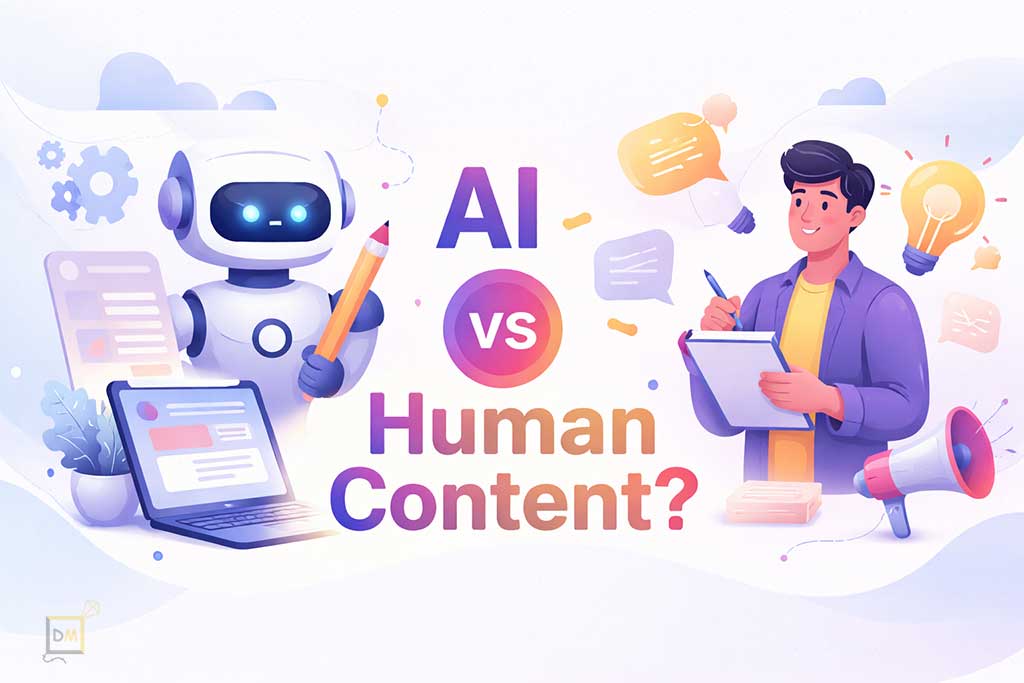
AI vs Human Content: What Actually Converts in 2026?
05
Apr
Content marketing has evolved faster in the last two years than in the previous decade. With AI tools generating blogs, ads, and social posts in seconds, businesses face a critical question:
Should you rely on AI or invest in human-created content?
The answer isn’t choosing one—it’s understanding how both work together to drive conversions.
What is AI Content and Human Content?
Understanding the difference between AI and human content is the first step to building a strategy that actually converts. Both have unique strengths, and knowing when to use each can directly impact your marketing results.
AI Content
AI content helps businesses scale quickly without compromising consistency. It’s ideal for generating large volumes of content, especially when speed and efficiency are top priorities.
AI content is generated using machine learning and NLP tools.
Examples:
- – Blog drafts
- – Product descriptions
- – Ad copy variations
- – Email campaigns
AI is fast, scalable, and cost-efficient.
Human Content
Human content brings authenticity that machines cannot fully replicate. It reflects real experiences, emotions, and insights that build deeper trust with your audience.
Human content is created by writers, marketers, or subject experts.
Examples:
- – Thought leadership articles
- – Brand storytelling
- – Case studies
- – Emotional ad copy
Human content brings originality, empathy, and strategic thinking.
Why Businesses Are Shifting Towards AI Content
Businesses today operate in a fast-paced digital environment where speed matters. AI enables brands to keep up with content demand while maintaining a competitive edge.
AI adoption has skyrocketed due to speed and efficiency.
Key Reasons:
- – Faster production
- – Cost savings
- – Consistency
- – Data-driven insights
However, speed alone doesn’t guarantee conversions.
Why Human Content Still Matters in 2026
Even with advanced AI tools, human creativity and emotional intelligence remain irreplaceable. These elements are critical for building meaningful connections with customers.
Key Advantages:
- – Emotional connection
- – Creativity
- – Brand voice
- – Strategic thinking
How AI Content Performs in Conversions
AI content performs best when the goal is to inform and attract. It ensures your content ranks well and reaches the right audience efficiently.
Where AI Wins:
- – Informational blogs
- – SEO content
- – Product descriptions
- – A/B testing
Why It Converts:
- – Matches search intent
- – Covers topics well
- – Uses proven structures
AI attracts traffic but may lack persuasive depth.
How Human Content Drives Higher Conversions
When it comes to influencing decisions, human content has the upper hand. It speaks directly to customer emotions and builds confidence in your brand.
Where Humans Win:
- – Landing pages
- – Sales copy
- – Case studies
- – Brand storytelling
Why It Converts Better:
- – Builds trust
- – Uses persuasion
- – Connects emotionally
Buyers need confidence, not just information.
AI vs Human Content: Key Differences That Impact ROI
Comparing AI and human content helps businesses understand where to invest their resources for maximum return on investment.
Quick Comparison:
- – AI = Speed, scale, efficiency
- – Human = Creativity, trust, conversions
AI content improves efficiency and SEO, while human content drives higher conversions through emotional connection and trust. The best results come from combining both.
What Research Says About Content Performance
Data-driven insights reveal how different types of content perform. These findings help businesses make smarter content decisions.
Key Findings:
- – AI boosts production by up to 60%
- – Human editing improves conversions by 30–50%
- – Hybrid strategies perform best
Content with storytelling converts up to 2x better.
Case Study: AI vs Human Content in Action
Real-world examples provide clarity on what works. This case study highlights the practical impact of choosing the right content approach.
Client: B2B Service Company
Two landing pages were tested:
Version A (AI):
- – SEO optimized
- – Structured
- – Generic messaging
Version B (Human):
- – Pain points
- – Storytelling
- – Strong CTAs
Results:
- – AI: 2.3% conversion
- – Human: 4.8% conversions
Human content nearly doubled conversions.
How to Combine AI and Human Content for Best Results
The most effective strategy is not choosing one over the other but integrating both for better efficiency and results.
Step-by-Step Approach:
- 1. Use AI for drafts and ideas
- 2. Add human insights and emotion
- 3. Optimize for conversions
This balance ensures both scale and impact.
What Type of Content Should You Use AI For?
Knowing where AI fits best can save time and resources while improving overall content performance.
Best Use Cases:
- – Blog drafts
- – SEO content
- – Social media captions
- – Email subject lines
AI ensures speed and consistency.
Why a Hybrid Strategy is the Future
The future of content marketing lies in collaboration between AI and human creativity, not competition.
Benefits:
- – Faster production
- – Better quality
- – Higher engagements
- – Improved conversions
This approach gives businesses a competitive advantage.
How to Make Your Content Convert in 2026
Conversion-focused content requires more than just information. It needs clarity, intent, and a strong connection with the audience.
Key Principles:
- – Focus on intent
- – Solve real problems
- – Use simple language
- – Add strong CTAs
- – Build trust
Content converts in 2026 when it combines clear messaging, user intent, emotional connection, and strong calls-to-action.
Final Thought:
Success in 2026 depends on how well you balance technology with human insight to create impactful content.
AI is transforming content marketing—but not replacing humans.
It’s about aligning with how people search, decide, and buy.
Use AI for speed and scale. Use humans for trust and conversions. Combine both to win.