- contact@digimenial.com
- Noida. UP

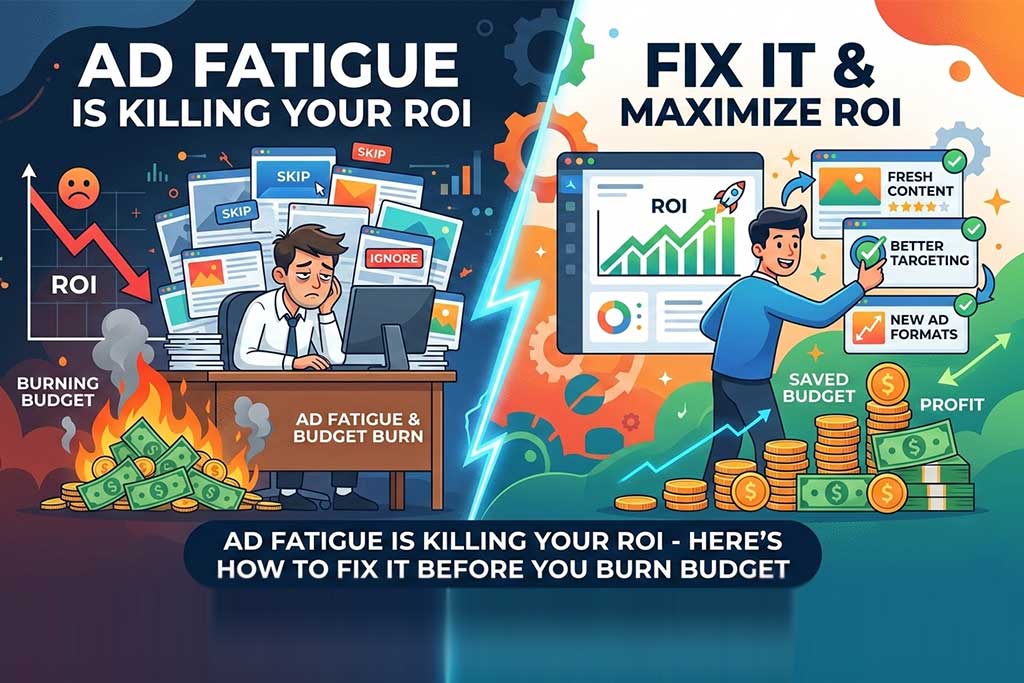
Ad Fatigue Is Killing Your ROI
Here’s How to Fix It Before You Burn Budget
27
Feb
If your ads were working last month and suddenly feel expensive, slow, or disappointing—this article is for you. Most businesses don’t lose money because ads “stop working.” They lose money because ad fatigue quietly creeps in, eats performance, and keeps draining budget long after warning signs appear.
Let’s break this down in simple business terms.
How Ad Fatigue Silently Eats Your Ad Spend
“The Invisible Budget Leak”
Ad fatigue doesn’t announce itself. Your ads still run, impressions still come in, and spend continues—yet results quietly decline. Audiences see the same message repeatedly and start ignoring it. You don’t notice immediately, but your ROI keeps shrinking week after week without obvious errors.
Why this hurts businesses:
According to Meta benchmarks, ad performance typically drops once frequency crosses 2.5–3.5 for cold audiences. Many brands continue spending 20–40% of their budget on fatigued ads without realizing it. That’s money being spent on people who’ve already tuned you out.
Common Mistakes That Cause Faster Ad Fatigue
“Good Ads, Bad Habits”
Most ad fatigue is self-inflicted. Businesses unknowingly speed it up by running too few creatives, scaling budgets too aggressively, or targeting narrow audiences for too long. When one “winning” ad performs well, teams hesitate to change it—and that delay becomes costly.
Typical mistakes businesses make:
- – Running one or two creatives for months
- – Increasing budget without expanding audiences
- – Targeting the same retargeting pool repeatedly
- – Repeating identical offers and messaging
Stat: Brands that rotate creatives weekly see up to 30% higher CTR stability compared to brands that don’t.
Metrics That Clearly Signal Ad Fatigue
“Your Dashboard Is Already Warning You”
Ad fatigue always shows up in the numbers first. The problem is most business owners look at sales only, not the early indicators. By the time sales drop, fatigue has already done damage.
Key metrics to watch:
- – Declining CTR (first red flag)
- – Rising CPM (platform charging more for attention)
- – Increasing CPA with stable traffic
- – Frequency creeping upward
Industry insight: A 15–20% CTR drop within 7–10 days often signals creative fatigue, not market demand issues.
Creative Refresh vs Audience Expansion
“Change the Message or Change the Crowd?”
One of the biggest mistakes businesses make is changing creatives when the audience is actually exhausted—or expanding audiences when the creative is stale. The fix depends on what’s fatigued.
How to decide:
- – If CTR drops but frequency is low → Creative fatigue
- – If frequency is high and CTR is stable → Audience fatigue
- – If both drop → You need both changes
Smart advertisers plan creative refreshes first, audience expansion second. Creativity is cheaper than new reach.
Platform-Wise Fatigue Differences
“Not All Platforms Burn Out the Same Way”
Ad fatigue behaves differently across platforms, and businesses often apply the same strategy everywhere—another costly mistake.
Meta (Facebook & Instagram):
Fatigue happens fastest due to high repetition and algorithm optimization. Creatives often last 7–21 days in high-spend campaigns.
Google Search:
Fatigue is slower but still real. Ad copy blindness and extension overuse reduce CTR over time, especially in competitive niches.
LinkedIn:
Audience fatigue happens fastest due to smaller audience pools. Frequency rises quickly, so creative rotation is critical every 3–4 weeks.
Stat: LinkedIn campaigns often see frequency 2x faster than Meta for B2B advertisers.
A Simple Fatigue-Prevention Framework
“Build Systems, Not Firefighting”
Businesses that win long-term don’t react to ad fatigue—they plan for it. A simple framework keeps performance stable without constant panic.
The framework:
- Launch with 3–5 creatives per ad set
- Monitor CTR, CPM, and frequency weekly
- Refresh creatives before performance drops
- Expand audiences before scaling budgets
- Rotate offers and angles, not just visuals
Brands using structured refresh systems reduce CPA volatility by 25–35% over time.
Case Study: How a DTC Brand Fixed Ad Fatigue and Recovered ROI
“From Declining ROAS to Profitable Scaling”
A mid-sized DTC footwear brand was spending ₹4,00,000/month on Meta ads. ROAS dropped from 3.8x to 2.1x in six weeks. The team assumed market demand had fallen—but the real issue was ad fatigue.
What was happening:
- – Frequency crossed 4.2
- – Only two creatives running for 45+ days
- – Budget increased without audience expansion
What they changed:
- – Introduced 6 new creatives with different hooks
- – Split messaging by awareness and retargeting
- – Expanded audiences before increasing budget
Results in 30 days:
- – CTR increased by 32%
- – CPA reduced by 27%
- – ROAS recovered to 3.4x
The product never changed. The system did.
Final Thoughts: Ad Fatigue Is a Business Problem, Not a Marketing One
Ad fatigue isn’t about ads “failing.” It’s about systems failing to evolve. Businesses that treat ads as static assets burn money. Businesses that treat ads as living systems protect ROI, scale sustainably, and outperform competitors.
If your ads feel expensive, tired, or unpredictable, don’t rush to blame the platform—or the product.
Start by asking one better question:
“Is my audience tired of hearing me say the same thing?”
Fix that, and ROI follows.